Beyond Bottles: How rPET Sheets, Fibers & Textiles Are Gaining Brand Traction in India
September 3, 2026
Beyond Bottles: How rPET Sheets, Fibers & Textiles Are Gaining Brand Traction in India
Bottle-to-bottle recycling represents the gold standard of rPET use. It preserves polymer purity, maximizes mechanical performance, and delivers the highest carbon reduction per unit, making it the most valuable way to close the loop. Yet as India’s 30% rPET-in-PET mandate takes effect, brands are discovering that securing this premium-grade material is just the beginning. Demand is soaring, supply is limited, and long-term sourcing is becoming a strategic challenge.
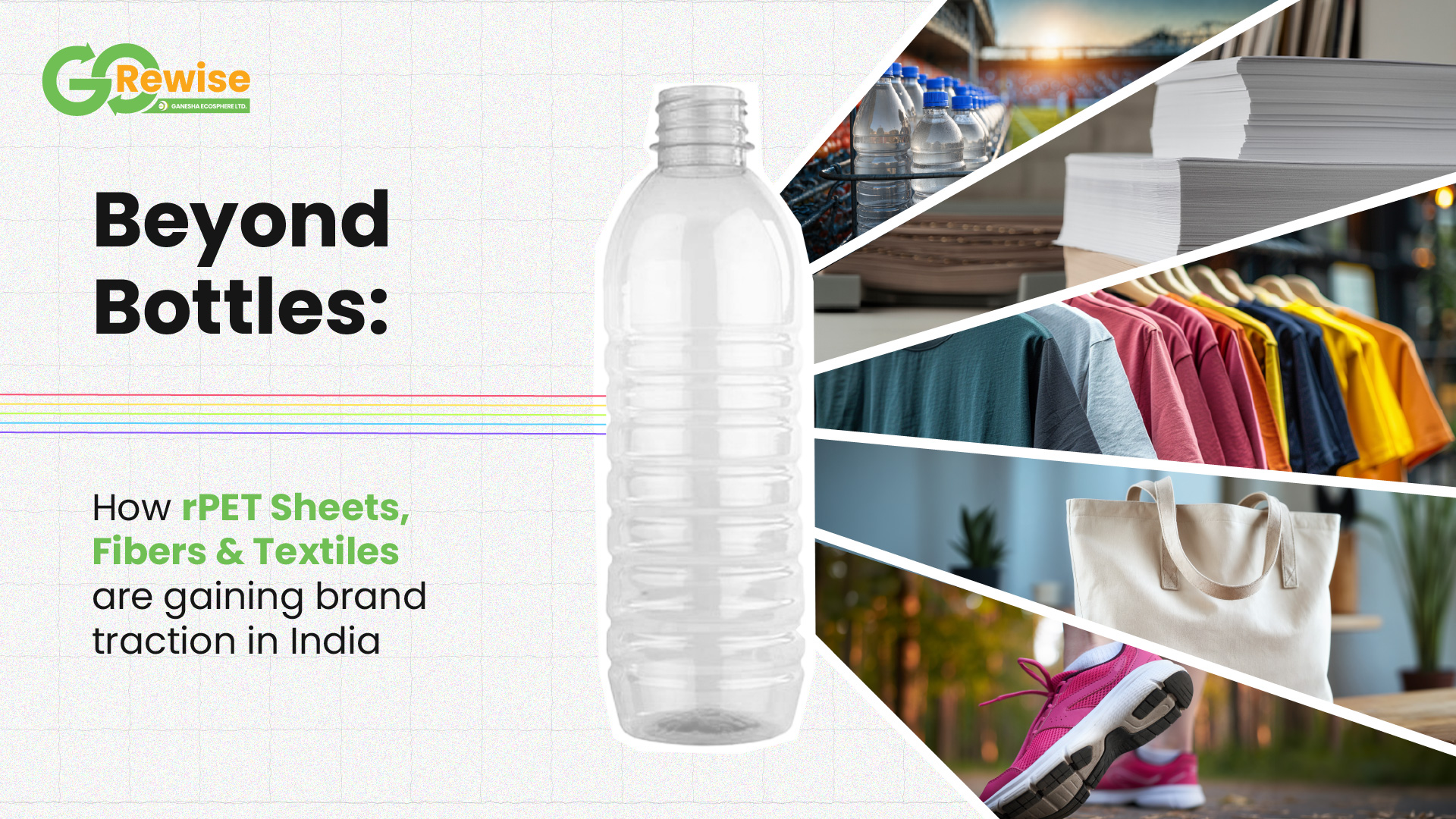
To stay ahead, leading brands are now looking beyond bottles. Thermoformed sheets, blister packs, performance fibers, and textiles are emerging as high-impact applications where rPET’s traceability, compliance, and mechanical performance create tangible ESG benefits. The story is evolving: bottle-to-bottle is the benchmark, but multi-stream rPET strategies are becoming the blueprint for brands that want to combine circularity, audit-ready traceability, and meaningful sustainability outcomes.
1) Policy tailwinds that opened new applications
- Food-contact greenlight: FSSAI has updated/expanded guidance in 2025 clarifying pathways for recycled PET in food contact, naming approved processes and manufacturers, tightening safety/labeling, and effectively unlocking demand for rPET sheets and thermoformed packs in foods, beverages and pharma.
- EPR pressure and credibility: Post-mandate, brands can’t rely on paper trails; they need traceable recycled inputs. That is pushing adoption in applications where batch-level traceability (lot IDs, QR, digital CoCs) can be embedded from sheet extrusion through thermoforming and from chip → fiber → fabric.
With regulatory clarity and strong audit pressure for finished packaging, rPET adoption in sheets/thermoform and fiber/textile applications is rising, driven by engineered quality, compliance readiness, and material performance, not by EPR obligations.
2) RPET sheets & thermoformed packs: the quiet growth engine
- Thermoform demand is rising across food, bakery, fresh produce, and personal care trays, segments where PET has a circularity edge vs. PS/PVC. Analysts flag steady growth in thermoformed containers/trays through 2035, with rPET adoption as a key material shift.
- Blister packs (FMCG & pharma): India’s blister market is growing, and FSSAI food-contact approvals plus pharma’s sterility/clarity needs position rPET sheet as an alternative to virgin PET for some primary/secondary packs (subject to line trials, barrier needs, and DMF/SFDA alignment).
Adoption playbook (what winning brands are doing):
- Run line trials with rPET mono-material sheets (targeting 30–80% recycled content) to maintain clarity & impact strength.
- Embed digital batch IDs/QR from sheet to formed pack for EPR evidence and recall discipline.
- Lock multi-year feedstock contracts with recyclers that can deliver food-grade pellets + spec-tight sheet extrusion.
3) rPET fibers & textiles: from pledge to product
- Macro demand is real: Recycled fibers are growing globally (textiles remain the biggest end-use), with recycled polyester a central lever for brands’ decarbonization targets through 2030.
- Policy + buyer pressure: Global initiatives (e.g., Textile Exchange’s 2025 recycled polyester push) still shape buyer scorecards; India’s manufacturing ambitions now sit alongside stricter climate expectations for mills.
4) Economics: Why brands are diversifying beyond bottle-to-bottle
- Supply security: India’s rPET sector has seen heavy investment, but procurement clarity is still evolving. To secure the recycled tonnage they need while competition for bottle-grade material heats up, brands are increasingly diversifying into sheet and fiber grades.
- Cost & volatility: Global rPET is on an upward trajectory; diversified applications create arbitrage, sheet and fiber contracts can sometimes be secured with more predictable pricing vs. bottle-grade spikes.
5) Quality & compliance: what separates pilots from scale
- Food-grade governance: Use FSSAI-approved processes/suppliers; maintain decontamination performance, migration testing records, and clear labeling. (Ops teams should map process IDs named by FSSAI listings to their Certificates of Analysis CoAs and internal specs.)
- Textiles performance: Specify IV, AA content, spin-finish, and flake/pellet specs to avoid yellowing and fiber breakage on high-speed lines; dope-dyed rPET can cut dyehouse loads and water/energy use.
6) What leaders are doing differently (actionable blueprint)
For Packaging Heads (Food, Bev, Pharma):
- Prioritise mono-material rPET sheets for trays/blisters where barrier/retort isn’t a blocker; create QR-linked batch passports for each thermoformed lot.
- Align with FSSAI-listed processes and suppliers; keep migration & Non-Intentionally Added Substances (NIAS) documentation audit-ready.
For Corporate/ESG Teams:
- Report recycled content by application (bottle, sheet, fiber) and disclose traceability tech used; investors increasingly discount generic “recycled” claims without evidence. (Aligned with the enforcement/credibility pressures documented for 2025.)
Bottom line
India’s rPET story is no longer a one-note “bottle-to-bottle” narrative. With food-contact clarity and apparel-side pull, rPET sheets, fibers, and textiles are where brands are quietly locking in recycled tonnage, audit-proof traceability, and meaningful decarbonization. The brands that win in 2026 will be the ones that treat packaging and textiles as twin rPET supply streams—specified tightly, traced digitally, and contracted long-term.
Go Rewise POV: Making rPET Traceable Across Sheets, Fibers & Textiles
What we supply
- Food-grade rPET (pellets/flakes) for sheet & thermoform applications (trays, blisters, clamshells).
- High-performance rPET fibers & yarns for apparel, athleisure, linings, and meshes.
How do we prove it
- Batch passports: unique lot IDs that travel from flake → pellet → sheet/filament → finished goods, mapped to CoA/CoC.
- QR/GS1 links on delivery notes and reels, enabling on-floor scans for instant provenance and spec checks.
- Immutable logs (optional): blockchain anchoring for high-stakes buyer audits and export programs.
- Food-contact discipline: decontamination performance data, migration/NIAS reports, and supplier process IDs aligned to current Indian requirements.
What brands get
- Audit-ready traceability for EPR and buyer due-diligence (packaging).
- Specification stability: controlled IV/AA, color/clarity, spin-finish parameters; dope-dyed rPET options to reduce dyehouse load.
- Measured impact: rPET programs that cut CO₂e by up to 60% vs. virgin baselines (application-specific LCA on request).
- Supply resilience: multi-year offtake options across both packaging (sheet) and textile (fiber) streams, reducing single-grade exposure.
- Co-label programs (on-pack or care-label recycled-content claims tied to batch passports).
Do you want batch-level traceability with a single partner? Contact us to know more.