EPR in 2026 Is No Longer Compliance. It Is Operational Discipline.
September 15, 2026
EPR in 2026 Is No Longer Compliance. It Is Operational Discipline.
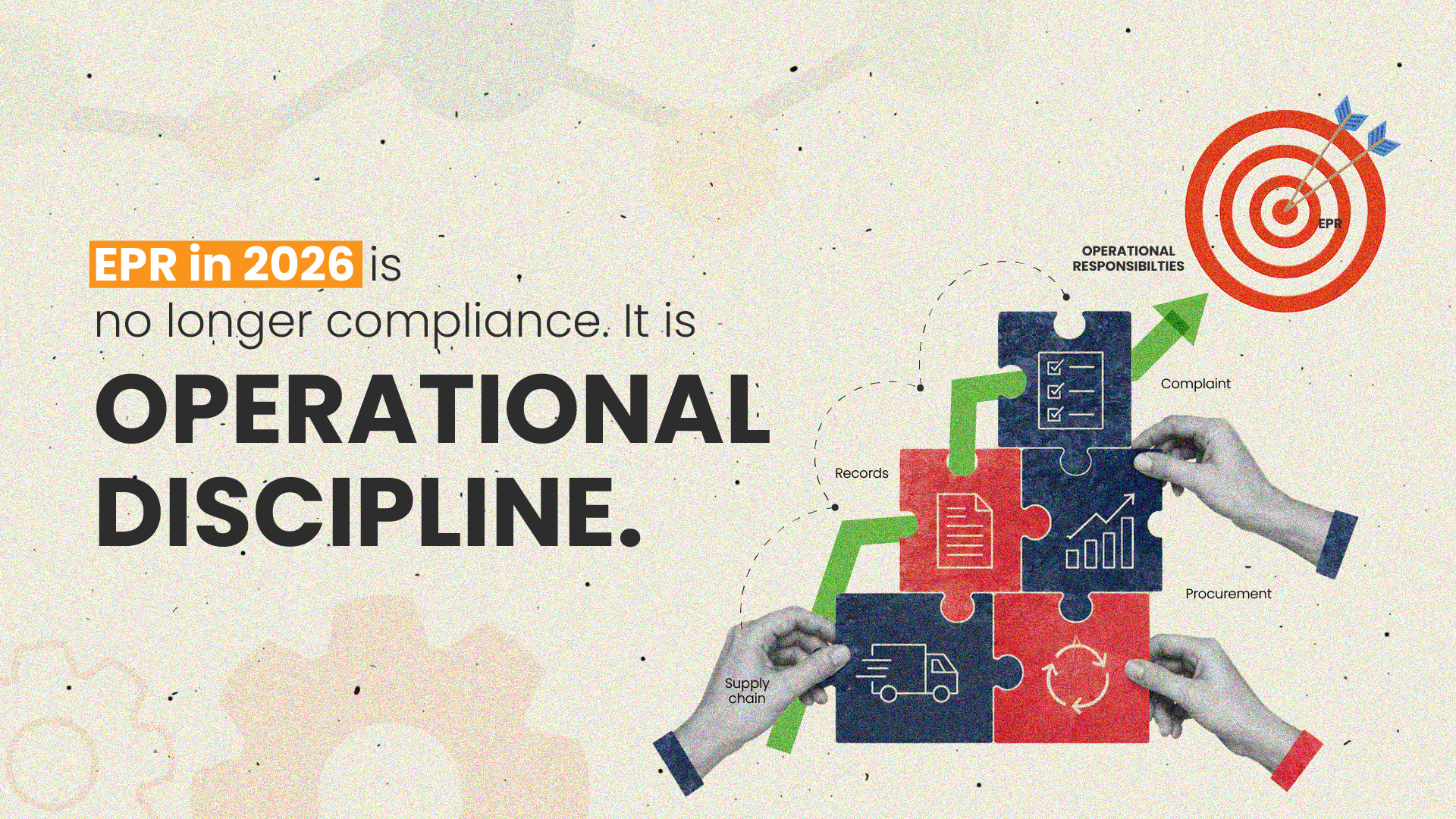
India’s Extended Producer Responsibility (EPR) framework has entered a new phase, defined by enforcement, traceability, and measurable accountability. The Plastic Waste Management (Amendment) Rules for FY 2025–26 and FY 2026–27 make it clear that compliance is no longer a reporting exercise. It is an operational mandate that directly impacts procurement, supply chains, and risk exposure. At its core, EPR now demands that obligations are met, proven, and auditable.
For PIBOs, the implications are immediate. Failure to meet targets does not result in a one-time penalty, it creates a compounding liability. Environmental Compensation is levied on the shortfall, and the unmet obligation is carried forward for up to three years. This carry-forward is not a deferment window, it is a structured clearance mechanism requiring at least one-third of the backlog to be fulfilled annually. Even if a company meets its current year obligation, previous shortfalls must be cleared in parallel. Failure to do so triggers penalties on the backlog, regardless of current performance.
The financial and regulatory consequences are layered and increasingly stringent:
- EPR target shortfall: Category I rigid plastics attract a base penalty of ₹2,900 per tonne, escalating with repeated defaults
- Filing delays: ₹5,000 for the first default, ₹10,000 for the second, ₹20,000 for the third
- Misreporting: Registration can be revoked for up to one year, with no re-entry during that period
This effectively transforms EPR non-compliance from a cost centre into a business continuity risk.
At the same time, the framework removes ambiguity around exemptions. No company is automatically exempt from EPR obligations. Exemptions apply only where the use of recycled plastic is explicitly prohibited by regulation, such as certain food or pharmaceutical applications. Supply constraints or commercial limitations are not considered valid reasons. The responsibility now sits firmly with PIBOs to establish reliable sourcing strategies for recycled materials.
The most significant shift, however, lies in how compliance is verified. The system has moved beyond declarations into a multi-layered validation mechanism that integrates documentation, digital tracking, and physical audits. For compliance to hold, companies must demonstrate alignment across multiple checkpoints:
- Documented proof: Purchase invoices for recycled materials, supplier certifications, and compliance approvals
- Portal cross-verification: Data submitted on the CPCB EPR portal is matched against recycler filings, with the lower value considered in case of discrepancies
- Registered sourcing only: Procurement must be from CPCB or SPCB registered recyclers, sourcing from unregistered entities does not count
- Audit readiness: CPCB and SPCB authorities can inspect records, facilities, and material flows, with third-party environmental auditors expected to play a larger role from 2026 onwards
- End-to-end traceability: Material must be traceable from waste origin to processing to final packaging batch, with adherence to applicable standards such as IS 14534:2023 and FSSAI requirements where relevant
This creates a closed-loop system where compliance is validated not just by what is reported, but by what can be verified across the value chain.
Reporting obligations further reinforce this structure. Annual returns must be filed by 30 June of the following financial year and include detailed disclosures on total plastic placed on the market, the split between virgin and recycled content, and reuse data. The system automatically cross-checks submissions against recycler data, ensuring that discrepancies are immediately flagged.
Taken together, these changes signal a fundamental transition. EPR is no longer managed at the level of reporting teams, it must be embedded into procurement systems, supplier networks, and operational workflows. Compliance now depends on three critical capabilities: consistent access to certified recycled materials, audit-ready documentation, and full traceability across the supply chain.
The margin for error is narrowing. Compliance gaps are no longer hidden within reporting cycles, they are exposed through data, cross-verification, and enforcement. As EPR continues to evolve, the role of the right partner becomes critical, not just to meet obligations, but to build a system that is resilient, scalable, and audit-ready.
If your organization is evaluating how to align with the 2026 EPR requirements or looking to strengthen its compliance infrastructure, we would be glad to support.
Reach out to us at marketing@gorewise.com to start the conversation.